
Closing the Loop: Airworthiness Directives
Just before [tail number] went in for a scheduled inspection, a new Airworthiness Directive (AD) was issued against the aircraft. We promptly sent [company name] an updated due list identifying the AD as an outstanding task requiring action before the aircraft could be considered airworthy.
However, during the inspection, the updated due list was never cross-checked against the existing work order. As a result, the AD was never added to the scope of work. Prior to departure, Computerized Aircraft Maintenance Program (CAMP) flagged the aircraft as unairworthy, but no maintenance personnel verified that the required work had been completed before releasing the aircraft. The aircraft ultimately departed [company name] with the AD still outstanding and overdue.
After returning to our hangar, the aircraft completed a passenger trip without the unairworthy status in CAMP being questioned or resolved. It was only after the flight, during a routine review, that CAMP records were compared against the log entry from [company name], confirming the AD had never been accomplished. The AD was then performed (and found not applicable) and properly documented and signed off in CAMP.
ERC Acceptance & Closing Notes:
- Sole source. Crew was unaware that the aircraft was unairworthy.
- The company system has a delay, and this caused the error along with a communication break down. Company plans to implement new policy to mitigate this going forward – emphasis to pilots on extra verification.
- Maintenance group is being retrained on new updated policy for vendor engagement and verification – possible September completion date.
Safety Takeaway:
Documentation Alone Doesn’t Close the Loop.
An updated due list is only effective if there’s a mandatory process to reconcile it against the active work order. Without that step, even accurate information can fail to reach the work being performed.
System Flags Require Human Verification, not Assumption.
CAMP correctly identified the aircraft as unairworthy, but a flag in a tracking system is not a substitute for a technician confirming the discrepancy against the maintenance log before release.
Small Gaps Compound When Unchecked Across Handoffs.
This event moved through multiple points: inspection, release, and a completed passenger flight where the discrepancy could have been caught. Building verification into each handoff, rather than relying on individual vigilance, is what ultimately prevents recurrence.
Airworthiness Directive Compliance Is Non-Negotiable
Airworthiness Directives aren’t advisory. They’re legally mandatory. Issued by the FAA under 14 CFR Part 39, an AD addresses an unsafe condition identified across a specific aircraft, engine, propeller, or appliance design. Once published, compliance is a regulatory requirement, not a discretionary maintenance recommendation.
This distinguishes an AD from many manufacturer service bulletins, which can sometimes be treated as optional depending on the operator’s approved procedures. An AD carries no such flexibility: it must be complied with by the deadline specified in the directive itself, whether that deadline is defined by flight hours, cycles, or calendar time.
Critically, an aircraft with an overdue or unaccomplished AD is not legally airworthy, regardless of how minor the underlying issue may seem. Operating the aircraft in that condition is a regulatory violation, with potential certificate and liability consequences for both the operator and the maintenance provider involved.
This is what elevates the event described above beyond a documentation oversight. The gap wasn’t simply a missed line item. It was a lapse in a legally mandated safety requirement, compounded by the fact that the AD’s status was never properly reconciled in CAMP before the aircraft departed for a passenger-carrying flight.
A Missed Crossing Altitude on the ILS Z RWY 6 at KTEB
While established on the final approach course for the ILS Z Runway 6 approach at Teterboro (KTEB), and cleared to land by Tower, the flight crew failed to cross the fix DANDY at its required altitude of 1,300 feet AMSL. The landing clearance had been issued by Tower as the aircraft passed VINGS, a point earlier along the approach.
The Pilot in Command intercepted the ILS glide slope at or near VINGS while level at 2,000 feet AMSL, then flew the glide slope down toward the final approach fix altitude of 1,300 feet, rather than descending to meet the required 1,300-foot crossing restriction specifically at DANDY. As a result, the aircraft crossed DANDY at approximately 1,470–1,480 feet AMSL, based on the best recollection of both pilots, still in the descent rather than level at the mandated altitude.
Tower informed the crew that they had failed to reach the required altitude at DANDY and reiterated the landing clearance for Runway 6. The aircraft landed without incident, with no further discussion of the altitude deviation, and taxied to parking after switching to Ground Control.
In review, the crew examined the ILS Z RWY 6 chart alongside an NBAA article addressing recent changes to the approach, specifically new mandatory crossing altitudes. The Pilot in Command identified the root cause as a chart misinterpretation: while the FMS correctly reflected the fixes, distances, and required crossing and final approach fix altitudes, the crew’s manual read of the chart led to an early glide slope intercept.
Following the flight, the crew conducted a thorough debrief between themselves, and separately with the Director of Operations, Chief Pilot, and Director of Safety, before submitting this report.
ERC Acceptance & Closing Notes:
- Sole source event.
- Mandatory crossing at DANDY has been recently changed from 1500 to 1300 ft.
Safety Takeaway:
Procedural Memory from Prior Versions of a Chart can Override with a Fresh Read
When a familiar approach is revised, pilots may unconsciously default to previously memorized altitudes rather than the newly published restrictions. A deliberate re-briefing of “what changed” is essential after any chart revision.
Charting Changes Carry Residual Risk for Experienced, Familiar Pilots
A restriction that’s technically inferable but not explicitly stated is a bigger hazard for currency-holding pilots who’ve flown the approach many times, since familiarity can breed assumption. Explicit callouts of new restrictions, and proactively reporting/recommending charting changes, help convert an individual near-miss into a fleet-wide safety improvement.
TEB ILS Z and LOC Z approach and the RNAV (GPS) Y approach to Runway 06 were amended.
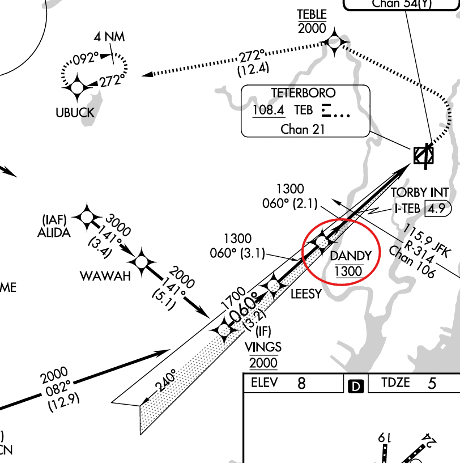
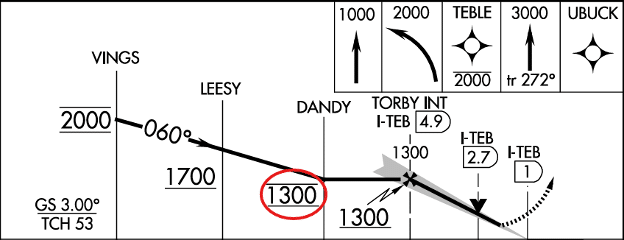
Planview and Profile Views were Extracted from FAA Terminal Procedures Publication for ILS Z or LOC Z RWY 6.
DANDY waypoint now requires a mandatory crossing altitude at 1,300 not 1,500.
An In-Flight Hypoxia Event at 20,000 Feet
While in cruise at 20,000 feet, direct to KDPA, I began experiencing what felt like the early stages of hypoxia. I immediately checked the aircraft’s pressurization system. Everything appeared to be functioning normally, with the cabin holding at 5,000 feet. Given that indication, I chose to continue for the time being.
As the flight progressed, my symptoms worsened: shortness of breath, difficulty focusing my eyes, a tingling sensation in my fingers, and increasing trouble with speech and motor control. I requested a lower altitude from ATC but was initially given only 17,000 feet. When my symptoms persisted, I informed the controller that I believed I was experiencing hypoxia and was then given 8,000 feet.
I put on the oxygen mask, not realizing at the time that it wasn’t set to deliver 100% oxygen. This appears to have kept my symptoms from progressing further, though it didn’t fully reverse them. The controller declared an emergency on my behalf and vectored me toward [airport]. As I descended through 13,000 feet, my symptoms began to subside. I was set up for a visual approach to Runway 23R and requested medical assistance on the ground. I was cleared to land, instructed to come to a full stop on the runway, and shut down there. After exiting the aircraft, I received medical attention.
ERC Acceptance & Closing Notes:
- Sole source. Symptoms of hypoxia were noted. Pilot received medical attention with O2.
- Aircraft maintenance confirmed pressurization system had no issues.
- Company sent out a reminder to pre-flight oxygen masks well.
- Pilot was removed from flight status and did not fly after this flight.
Safety Takeaway:
Know & Test Your Oxygen Equipment Before You Need It Under Stress
The mask was donned correctly but not set to deliver full oxygen flow, a critical detail that’s far easier to get right during calm, routine training than during a real emergency when cognitive function is already impaired.
Declare Early and Directly
Requesting a lower altitude got a limited response; explicitly stating “I believe I’m experiencing hypoxia” is what triggered the controller’s emergency declaration and priority handling. Clear, specific language about a suspected physiological emergency should be used immediately, not held back until symptoms are severe.
Hypoxia can Occur at Any Altitude
Risk changes dramatically depending on how high you are and how you’re getting oxygen. Here is the breakdown:
Why It can Happen at “Normal” Cruising Altitudes Despite Pressurization
This is exactly what happened in the case above: flying at 20,000 feet in a pressurized aircraft doesn’t guarantee protection, because:
Equipment Malfunction: A pressurization system failure, leak, or malfunctioning valve can allow cabin altitude to climb even if instruments briefly show normal readings, or the system may be borderline without fully failing.
Physiological/Individual Factors: Fatigue, dehydration, illness, smoking, certain medications, alcohol in the system, or even mild anemia can lower a person’s tolerance to reduced oxygen. Someone can become hypoxic at a cabin altitude that wouldn’t affect most healthy people.
Cumulative or Gradual Exposure: Hypoxia doesn’t always announce itself immediately. Its onset can be insidious, gradually impairing judgment and self-awareness before a person consciously registers something is wrong. That’s part of why it’s so dangerous.
Altitude Ranges and Typical Risks (Set as Approximates)
- Sea level to 8,000 ft: Hypoxia risk from altitude alone is minimal for a healthy person.
- 8,000–12,000 ft: Mild hypoxia effects can begin. Slightly reduced night vision and minor judgment effects, though most people won’t notice without testing. This is why the FAA sets 12,500 ft as the threshold above which supplemental oxygen becomes required for pilots after 30 minutes of flight time (14 CFR 91.211).
- 12,000–14,000 ft: Oxygen is required for the flight crew if flight time above 12,500 ft exceeds 30 minutes.
- Above 14,000 ft: Oxygen is required continuously for flight crew.
- Above 15,000 ft: Oxygen must be provided to each occupant of the aircraft, not just the crew.
- 25,000 ft+: Time of useful consciousness drops sharply, often just a few minutes without oxygen.