
The Altitude That Wasn’t — How Confirmation Bias Led to an Altitude Deviation
I picked up our clearance from Clearance Delivery a few minutes before takeoff. While I copied it and began programming the FMS, the Captain started running systems checks, including tests of the Aural Warning System. I jotted the clearance down in shorthand — “[airport code] M8 AF3 133.5 6225” — and read it back to ATC, receiving a correction on the departure frequency. As I continued entering the route into the FMS, warning tones and chimes from the systems checks were sounding around me, and in the process I never entered our assigned altitude into the Altitude Pre-Select.
The Captain, glancing at my shorthand, saw the “8” in “M8” — the name of our departure procedure — and dialed 8,000 feet into the preselect. He then asked me, “Are we cleared to 8,000?” I looked up, saw 8,000 already sitting in the preselect, and replied, “Yeah, 8,000.” At some point I even glanced back at my own shorthand, saw the “8,” and took that as further confirmation. We briefed the departure either before engine start or while taxiing out to Runway 4L, and during that briefing the Captain read the top altitude off the chart — which showed 3,000 feet — and asked again if we were cleared to 8,000. I said yes again.
We were cleared for takeoff with an immediate turn to roughly heading 250. Climbing through about 1,500–2,000 feet MSL, I checked in with Departure and stated we were “climbing to 8,000.” The controller acknowledged the call without comment. About a minute later, she asked what altitude we were climbing to and instructed us to maintain 4,000. I replied that we were passing 4,500 feet, and she told us to stop the climb immediately. The Captain, who was hand-flying, arrested the climb right away and descended us back to 4,000. She asked once more what our clearance altitude was, and I again said 8,000 — at which point I asked if there would be a number to call, and she confirmed there would be. We were never aware of any conflicting traffic during the event.
After landing in [airport code], I called the number and was told that Clearance Delivery’s tape confirmed we had read back 3,000 feet — not 8,000. Looking back, I believe the “8” in “M8” caught the Captain’s eye and led him to dial 8,000 into the preselect, and I then used that preselect setting as my own confirmation of the assigned altitude, rather than checking it against what ATC had actually said. Confirmation bias worked its magic on both of us. I was also distracted during the clearance copy by the preflight checks running in the background, which split my attention across receiving the clearance, giving the readback, and programming the FMS simultaneously. It’s not our company’s SOP, but I now believe it would help if both crew members could obtain departure clearance together whenever possible. Another contributing factor was that the departure controller didn’t catch or correct the discrepancy when I stated “climbing to 8,000” on our initial check-in. As the only pilot who actually heard the clearance, I accept responsibility for the deviation — but I’d also note that one pilot shouldn’t be running cockpit checks with an active aural warning system while the other is trying to copy a clearance; the noise is simply too distracting.
Looking back, a few things would have prevented this: both pilots receiving the clearance, treating clearance copy as sterile cockpit time, avoiding leading questions like “cleared to 8,000?” in favor of open ones like “what’s our assigned altitude?”, never dialing in an altitude you didn’t personally hear from ATC, and asking ATC to confirm anytime there’s uncertainty. I’d also add that over-abbreviating clearance shorthand contributed directly to this error — if I had written “Cleared to [airport code] via MDW Eight Dep, Maintain 3000′, Dep Freq 133.5, Sq 6225” instead of compressing it down to “[airport code] M8 AF3,” this almost certainly never would have happened.
ERC Acceptance & Closing Notes:
- Sole source. Yet to be reviewed.
Safety Takeaways:
Confirmation Bias is a Silent Hazard
Once a number is spoken aloud or entered an instrument, both pilots tend to anchor on it as fact, even when it was never verified against the original clearance. Always trace back to the source, not to what a crewmember said a moment ago.
Never Dial in an Altitude You Didn’t Personally Copy from ATC
If you didn’t hear it firsthand, verify it against the written clearance (or ask ATC to confirm) before it goes into the FMS or preselect. Do not let time pressure be the reason to not check clearance again.
Treat Clearance Copy as Sterile Cockpit Time
Running aural warning checks or other non-essential tasks while one pilot copies a clearance creates dangerous distraction during a high-stakes moment.
Have Both Pilots Copy the Clearance When Possible
A second set of ears creates a built-in cross-check and removes a single point of failure.
Wrong Airport Landing — When “Field in Sight” Wasn’t the Field
We were being vectored toward the IAF for KSSI when we called the field in sight and were cleared for the visual approach to Runway 22. We canceled with an approach, squawked VFR, and switched over to CTAF. We made our position calls as expected, and at one point our attention was drawn to another aircraft back taxiing on Runway 22 — a normal, if distracting, thing to visually track during a visual approach into an uncontrolled field. Between the runway alignment looking right, the traffic on the runway matching what we’d expect, and no red flags jumping out at us; we continued the approach and landed. It wasn’t until afterward that we realized we hadn’t landed at KSSI at all — we’d landed at KBQK, an airport with a similar runway layout and orientation a short distance away.
Nothing about the sequence felt wrong in the moment. We had the “field” in sight, we were cleared for the visual, and the runway environment we saw lined up with what we expected to see. The presence of another aircraft on the runway added a layer of false confidence — it looked like a normal, active airport doing normal airport things, which reinforced our assumption rather than prompting us to double check it. Once visual and off the approach, we didn’t cross-reference the airport diagram, runway numbers, or other identifying features against what we were actually looking at — we were flying to what looked right, not to what was confirmed correct.
In review, this was a case where two similar-looking airports and a visual approach combined to erode the normal safeguards we’d rely on for airport identification. Going forward, we agreed a few extra layers of redundancy — verifying the identifying features of the airport rather than relying on runway orientation alone and staying disciplined about cross-checking even after “field in sight” is called would go a long way toward preventing this from happening again.
ERC Acceptance & Closing Notes:
- Sole source event. Crew debriefed, counseled, and retrained on visual approaches. New policies were added to FOM. Traffic in the vicinity caused confusion.
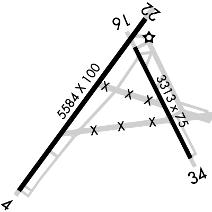
St.Simons Island(KSSI) Airport Runway Diagram
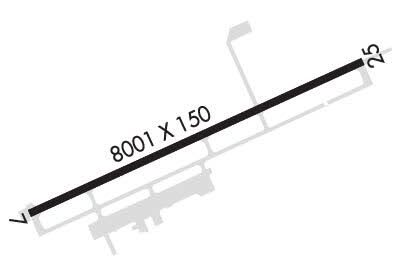
Brunswick Golden Isles(KBQK) Airport Runway Diagram
Safety Takeaways:
“Field in Sight” is a Starting Assumption, not Verified Fact
Especially near similarly-oriented airports, visually acquiring “an” airport is not the same as visually acquiring “the” airport. Positively identify the field before committing to the approach.
Keep the Approach Armed, even when Going Visual
Leaving an instrument approach armed provides a live cross-check. If the aircraft’s track diverges from the approach course to the correct airport, that’s an immediate, objective flag that something is wrong, independent of what your eyes are telling you.
Cross-reference more than runway orientation. Similar runway headings and layouts are a well-documented cause of wrong-airport landings. Confirm field elevation, runway numbers, airport layout, surrounding terrain/water features, or GPS-derived distance and bearing, not just “a runway that looks about right.”
A similar event occurred last year with a different flight operation. With multiple airports around KSSI, the airport must be reviewed if ever selected for landing destination. For 2025 Case Study, please refer here.
Factors Causing Confusion
Overlapping Airspace & Radio Congestion
Because they are only 7 miles apart, pilots operating at either field can easily hear traffic from the other. They use highly similar Common Traffic Advisory Frequencies (123.05 MHz for KSSI vs. 123.00 MHz for KBQK), meaning a misdialed digit can result in a pilot broadcasting intentions to the wrong field.
Identical Regional Context
KBQK and KSSI are about 7 nautical miles apart. Both fields serve the “Golden Isles” region of Georgia (Brunswick/St. Simons Island). Pilots unfamiliar with the area often pull up the wrong airport diagram or approach plate because both airports feature “Brunswick” or “Golden Isles” prominently in automated weather headers or regional search tools.
When Repeated Verbal Confirmations Weren’t Enough
At [international airport], we arrived two hours before departure and requested a GPU from the handler due to the airport’s APU restrictions, also advising that we’d need to start one engine before disconnecting the GPU at departure — otherwise we’d have to power down with passengers on board. The handler agreed. We later started the APU during the noise abatement window, double-checking since passengers had arrived early, and again confirmed our engine-start plan. Both times, we got “okay” confirmation.
Once passengers boarded, a different pushback team arrived to tow us onto the taxiway. I repeated the same request to them, but this time was told we needed ground control’s permission first. Ground told us to wait for the marshal car. Once it arrived, some confusion broke out among the handlers — a rapid exchange in Italian — and we were told they needed to check with an operations supervisor. A few minutes later, with the marshal car present, we were cleared to start the right engine. We closed the cabin door, confirmed once more with ground control, received permission, started the right engine, and signaled for GPU disconnect. After being towed clear and the tug departed, we started the left engine, ran our checklists, and taxied out.
I always review airport notes and am especially cautious in Europe given noise and environmental sensitivities — which is why I checked in with handlers repeatedly. I believed we were operating within local procedure, particularly with the marshal car present and ground control’s approval. In hindsight, the lesson is to clarify stand-specific departure procedures at arrival, and reposition the aircraft the day before if needed to avoid this kind of last-minute coordination.
ERC Acceptance & Closing Notes:
- Non sole source – safety and compliance from a local airport reached out to company. Crew explained they were in communication with ground handlers.
- Crew thought they were allowed to start engines.
- Miscommunication and language barrier were main contributing factors.
- Company sent out lessons learned and shared local airport procedures.
Safety Takeaways:
Verbal Confirmation from Ground is not the Same as Procedural Authority
Multiple handlers each said “okay” independently, but none of them may have had the authority to actually approve the request as shown by the eventual need to escalate to ground control and an operations supervisor. Repeated informal approvals can create a false sense of security.
Non-standard Procedures Should be Confirmed with the Right Authority Before the Day of Departure
Starting an engine before GPU disconnect is an atypical sequence at many international airports. If a procedure deviates from the norm, it’s worth confirming with airport operations or ground control in advance, not working it out in real time on the ramp with passengers aboard.
Confusion Among Ground Personnel is a Signal to Pause, not Push
When the handlers began conferring rapidly in Italian and needed to escalate internally, that hesitation was information, it suggested the request wasn’t fully aligned with standard local procedure, even though it was eventually approved.