
A Lesson in ATC Coordination: When “VFR” and “IMC” Don’t Match
I departed [airport] under IFR bound for [airport], cleared via radar vectors to DUNKK and then direct. Shortly after takeoff, Boston Approach offered me a choice: route 15 miles east of Boston, or fly west of the city. I chose the western routing and was given a series of vectors — first 230, then 180 — to make my way around.
Over the course of the flight, I was handed off several times: Boston Approach on 124.4, then 120.6, followed by Providence Approach on 123.67, who eventually cleared me direct to [airport] before returning me to Boston Approach on 118.2. I remained on an IFR clearance throughout and entered IMC roughly a minute after departure.
After picking up the [airport] ATIS — which listed Runway 6 as active, with Runway 33 available on request — I told Boston Approach I had the weather and asked for Runway 33. They replied that both runways were in use.
A few minutes later, while level at 3,000 feet, Approach asked if I had the field in sight. I responded that I was still in IMC. Their reply caught me off guard: they had me logged as VFR. I clarified that I’d been IFR — and in IMC — since the moment I lifted off.
Out of caution, ATC issued a new clearance back to [airport] and had me descend. Once I reported the field in sight, I was cleared for the visual approach to Runway 33 and landed without further incident.
Suggestions:
A mismatch between what a pilot believes their flight status to be and what ATC has on record is a serious issue — one with implications for separation, radio-failure procedures, controller responsibilities, and more. In this case, I was flying under IFR the entire time, yet was somehow logged as VFR through the flight.
I can’t say for certain what caused the discrepancy, or whether it was related to the handoff between Boston Approach and Providence Approach and back. But the incident highlights a real opportunity for improvement in how flight status is tracked and communicated during transitions between facilities.
ERC Acceptance & Closing Notes:
- Sole source.
- Pilot followed up with ATC two different times -ATC stated they are looking into this.
Safety Takeaway:
ATC Staffing Shortage
- As of mid-2026, the FAA was roughly 3,000 certified controllers below its staffing target, employing close to 10,800 fully certified controllers against an internal goal near 13,800
- This amounts to a gap of about one in five positions across towers, radar rooms, and the regional centers that hand planes from one sector to the next
Effects of the shortage on day-to-day operations
- Fewer controllers means less informal cross-checking in the room — a second controller may not be available to catch a misread altitude or a missed handoff
For pilots out there, measure and keep a certain space for ATC to make mistakes. ATC is in the transition period of hiring more controllers in the next few years. Pilots can make mistakes, and ATC can, too.
The Runway That Wasn’t: A Close Call on a Stormy Approach
The weather had already made the decision hard before the crew saw a runway.
Descending out of FL450 toward [airport], the flight ran straight into a line of thunderstorms sitting over the arrival. What should have been a routine descent turned into a string of course changes — a left deviation here, a lower altitude there, then an entirely new arrival as controllers worked to thread traffic around the cells. Nearby, aircraft bound for DFW was peeling off and diverting around the same weather. The frequency was busy. The picture kept changing.
The crew pressed on methodically: descend to 10,000, deviate left as needed, then down to 6,000. They checked in with Approach, gave their ATIS and altimeter, and were cleared toward [airport]. A quick second check of the ATIS showed a change — the landing runway was now more favorable, at least.
Still boxed in by weather on all sides, the crew asked for vectors onto the ILS outside the final approach fix. But the geometry ATC gave them was tight — so tight that turning back to intercept final the normal way would have meant a 220-degree turn the other direction. They were on an abbreviated downwind, closer in than usual, working with less time and less room than a typical approach affords.
Then came the call: airport at their two o’clock, about three miles out. The First Officer looked, and called it — airport in sight. Cleared for the visual, they switched to Tower.
From there, everything felt normal. The crew squared what they took to be their downwind. The First Officer turned to base, then called for gear down and the landing checklist. The Captain, working through the checklist items, was heads-down for exactly the moments that mattered most — the turn to final.
It wasn’t until rollout to final that the Captain looked up.
Something was wrong. The runway in front of them wasn’t [airport]. It was a parallel airport nearby — close enough, similar enough, that from the compressed downwind and tight pattern, it had looked right the whole way in.
The Captain didn’t hesitate. “Climb.” He took the controls. The First Officer, quick to adjust, got on with tower to sort out the situation while the aircraft powered away from the wrong runway. They came back around, entered over midfield, flew a proper left downwind, and landed at the correct airport without further incident.
ERC Acceptance & Closing Notes:
High workload for crew and ATC.
Crew suggestions – Never accept a visual clearance into an airport unless both pilots see and agree the correct airport.
Corrective Action:
Conversation with the pilot was conducted. Operator shared the significance in the pilot’s meeting about visual approaches, ensuring the FMS is set up properly and referenced for situational awareness to prevent this type of occurrence.
Safety Takeaway:
“Airport in sight” needs to mean both pilots, not one.
- The core failure point was that only the First Officer visually confirmed the airport before the crew accepted the visual clearance. A visual approach clearance shifts responsibility for navigation from ATC to the pilots’ eyes — that responsibility should be shared and cross-checked, not delegated to a single callout.
Parallel/look-alike airports are a known hazard, and weather makes it worse.
- Nearby airports with similar orientation are a recognized source of wrong-airport and wrong-runway events. Add in thunderstorm deviations, a changed arrival, and radio congestion from other aircraft diverting, and the normal cues pilots rely on (expected position, timing, radio chatter) get scrambled — increasing reliance on a quick visual ID that may not get proper scrutiny.
Stacked minor pressures, not one big failure, created the risk.
- No single factor here was disqualifying — weather deviations, a runway change, a busy frequency, and a tight pattern are all things crews handle routinely. The lesson is about cumulative risk: several ordinary pressures compounding at once should raise a crew’s internal caution level, even when nothing individually seems alarming.
Parallel runways or nearby airports demand extra attention during visual approaches, especially under compressed vectoring.
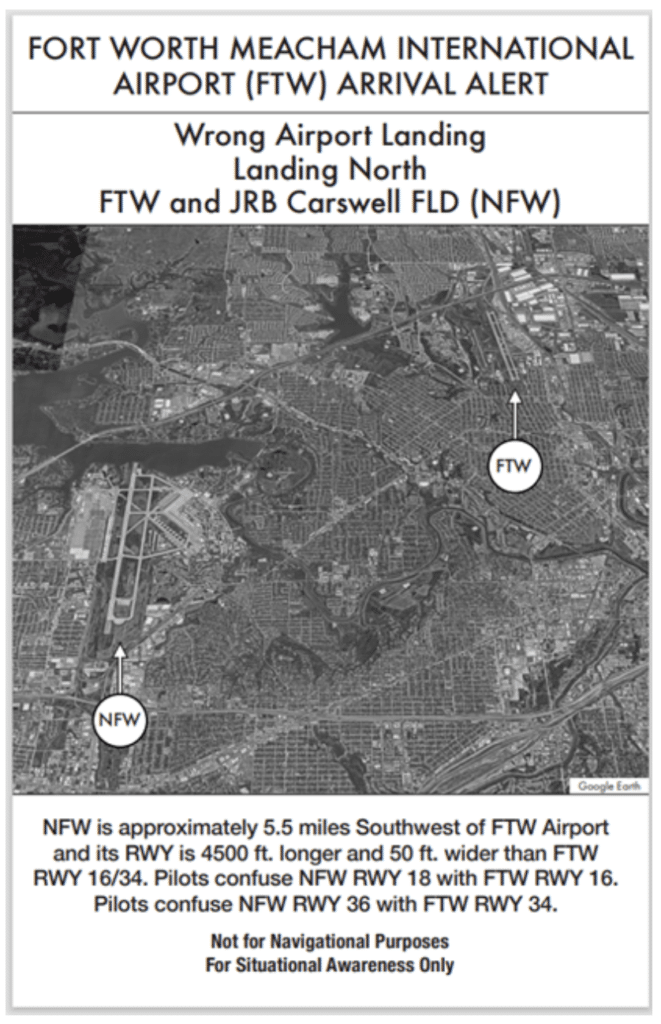
(Extracted form Arrival Alert Notices page from FAA’s website : https://www.faa.gov/aan)
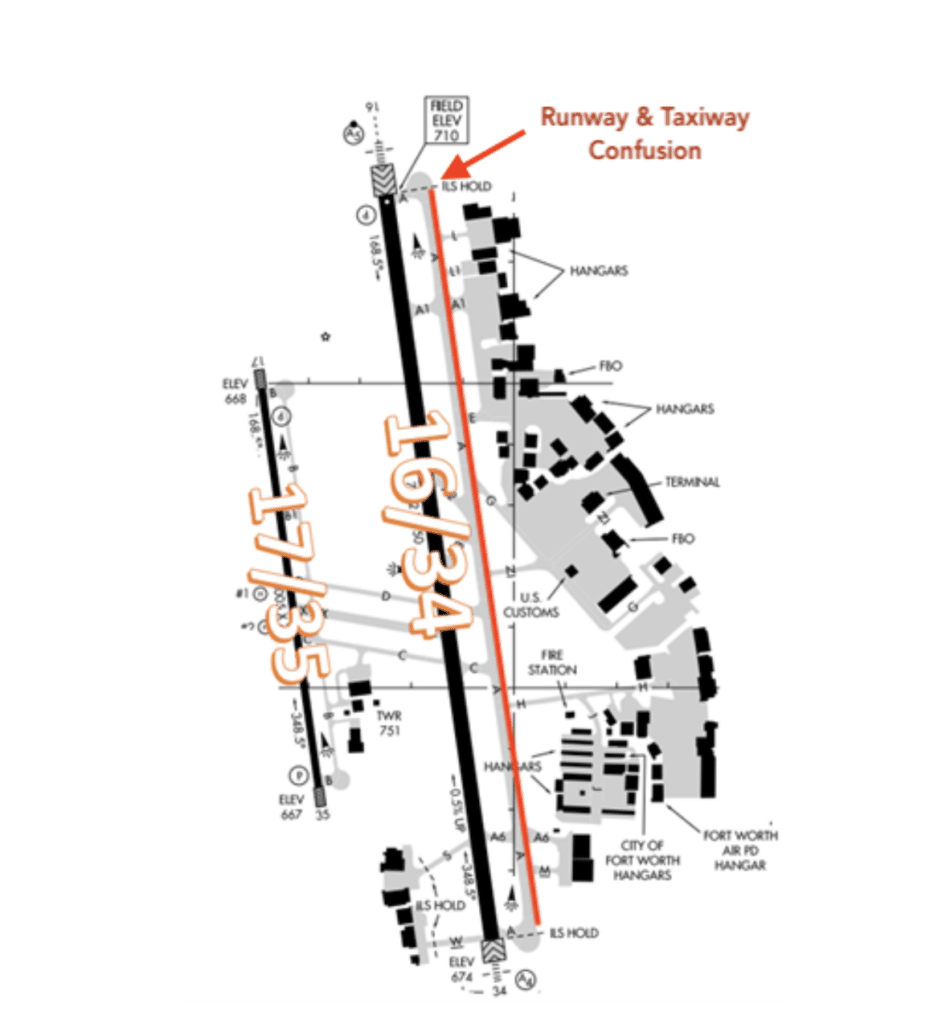
A confusion between near parallel runways and Taxiway A can be identified.
Importance: A visual clearance should not be accepted until both pilots have independently identified and agreed upon the correct airport — not just one crewmember’s callout.
When MELs Don’t Match Reality
Following an FAA ramp check at KPIT, a crew discovered inoperative cabin emergency floor lighting under the rear two seats. Maintenance Control issued an MEL to defer the item, and the flight continued. Over the next two days, additional inoperative items surfaced during routine preflights: multiple no-smoking/fasten-seatbelt signs, and further emergency floor lighting. Each was written up and deferred under separate MELs.
On the third day, the crew and First Officer reviewed the most recent MEL against the aircraft’s actual condition and identified a mismatch between what the MEL described and what was truly inoperative. Despite initial reassurance from Maintenance Control that the aircraft was dispatchable, the crew escalated their concern through two calls to the Systems Operations frequency, reaching first an Assistant Director of Operations and then the Director of Operations. Following discussion, all parties agreed the aircraft could not continue operating under the existing MELs.
It was at this point that the crew realized two prior revenue flights have been flown the day before with the aft cabin floor lighting deferred under an MEL that had been incorrectly applied. It was also determined that the seatbelt/no-smoking sign MEL required blocking the affected seats from passenger use — a restriction the crew had not been informed of and had not applied, having instead relied on verbal PA announcements as their understood method of compliance.
ERC Acceptance & Closing Notes:
Crew and maintenance control were interviewed.
New General Maintenance Manual(GMM) procedure was implemented due to event.
Corrective Actions:
Maintenance bulletin was posted with updated pilot responsibilities vs maintenance control responsibilities.
New checks have been added to 30 hour inspection.
Safety Takeaway:
Cross-check MEL numbers against actual conditions.
- A deferral should be verified against the aircraft’s specific inoperative equipment, not accepted solely on Maintenance Control’s issued reference.
Read MEL procedures in full, every time.
- Compliance requirements (placarding, seat-blocking, operational limitations) must be applied exactly as written — not interpreted or substituted based on assumption.
Escalate when something doesn’t add up.
The crew’s decision to involve operational leadership — even after initial pushback to continue — is the behavior that ultimately corrected the discrepancy.