
Fatigue and a Runway Change: Lining Up for the Wrong Runway
We departed late for [airport] on August 4 after our passengers were routinely late, taking off at 0806Z against a scheduled 0659Z and landing at 1029Z against a scheduled 0914Z. About 1 hour 20 minutes before landing, I pulled the [airport] ATIS via ACARS. Weather was MVFR with landing runways 25L and 24R, so we set up and briefed the ILS 25L.
While descending on the IRNMN2 arrival, I listened to the ATIS again and found it had changed: Runway 25L was now closed. We were near the bottom of the descent and receiving vectors when the ATIS told us to expect the ILS to 24R. We quickly loaded the new procedure into the FMS, understanding we were going to 24R, but ATC had cleared us to 25R. ATC then asked why we were lining up for 24R when they had cleared us to 25R. We apologized, maintained altitude as instructed, and were vectored for the ILS 25R. We set up for it and completed the flight without further issues.
It was very late at night, and both of us are East Coast based, so we were fatigued and did not react quickly or correctly to the runway changes. In hindsight, I should have rested more before an all-night flight, checked the ATIS earlier to make sure it was current, and recognized our fatigue and found a way to manage it.
ERC Acceptance & Closing Notes:
- Expectation bias was a contributing factor.
- Crew were fatigued. Safety and pilot meeting discussion about our fatigue management program. Crews should speak up when fatigued, with no reprisal for speaking up.
Safety Takeaways:
Time Zones Matter
Both pilots were East Coast based, and a 0329 PDT landing was 0629 EDT, deep into their circadian low. Planning rest around home-base time, not local time, can make a significant difference.
Fatigue Degrades Skills
Rapid reprogramming, reconciling conflicting information, and catching a mismatch all suffer when pilots are tired. When a late-night arrival is likely, consider fatigue before the flight, not only once it shows up in the cockpit.
Speak Up and Verify Early
Asking “which runway are we cleared for?” costs seconds. A deviation caught by ATC after the aircraft is already lining up costs far more.
Delays Compress the Margin
The late departure pushed the arrival deeper into the night. Late-running trips are a good moment to reassess crew alertness and to brief how workload will be shared if something changes.
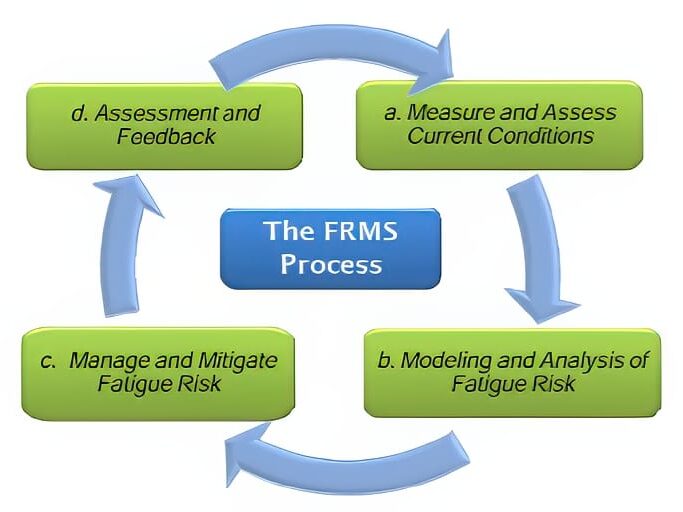
A Flight Risk Management System (FRMS) is not only a written set of rules. Under AC-120-103A, it is a living system in which certificate holders detect and adapt to fatigue’s impact on the operation, and employees carry out the actions that put those policies and procedures into practice.
Application for this Case Study:
1) Measure and Assess Current Conditions
- The trip departed 67 minutes late and landed 76 minutes late, pushing the arrival deeper into the night.
- Landing at 0329 PDT is 0629 EDT. For a crew on East Coast body time, the descent happened at the very end of the early-morning low point.
2) Analyze Fatigue Risk
- A predictable performance low point is of greater concern when it coincides with critical flight tasks. A late runway change during descent into a busy Class B airport is exactly that kind of coincidence. The probability of fatigue was high, and the consequence was a possible wrong-runway or wrong-airport alignment.
3) Mitigate Fatigue Risk
- Scheduling or planning rest around home-base body time, with a pre-duty nap
- Adding a buffer when a trip is likely to arrive in the low-alertness window
- Briefing before the descent how to handle a late runway change, for example by asking for delay vectors
- Considering an augmented crew or a later departure for overnight trips
4) Assess and Feedback
- Gather evidence on whether the changes reduced fatigue, and note that new routes, schedules, and demands can bring new fatigue pressures.
- AC-120-103A describes layered defenses: scheduling, personal use of rest opportunities, error detection through CRM, and objective post-event analysis. This event shows where those layers held and where they did not.
Silence on the Frequency: A Near Runway Conflict
We were preparing to depart [airport], a non-towered airport. A King Air and a TBM had taxied out ahead of us, and a [other company] regional jet was approaching to land. [Other company] crew chose Runway 13, so the King Air followed suit. We announced our taxi intentions, including our MEDEVAC callsign, and proceeded to Runway 13 behind the departing King Air. The TBM, however, chose to taxi for Runway 31. Given the timing and positions, this had already created a conflict with the arriving [other company], which had to stay on the runway after landing so the TBM could taxi past. Once [other company] began clearing the runway, the King Air lined up and took off after the [other company] had fully cleared.
As the King Air departed, we announced that we would be taking the runway. We could not recall hearing from the TBM since its pilot had talked to the [other company], so after a brief silence I asked on frequency whether the TBM had heard our call. By then we were already rolling onto the runway, which looked clear to the best of our ability. However, a change in the runway’s slope kept us from seeing all the way to the far end. With no response from the TBM, I hesitated, and we came to a stop in position on the runway.
Shortly after we stopped, the TBM appeared airborne over the horizon, tracking directly toward us. We stayed put, and the TBM made a left turn to avoid overflying us. I checked in with my SIC, who was visibly shaken, to confirm she was comfortable continuing. After a brief conversation we completed the takeoff safely and debriefed once sterile cockpit ended in the air.
I believe several factors combined: the TBM choosing a runway opposite to the rest of the traffic, a communication breakdown between us and the TBM, my failure to ensure the runway was clear beyond any doubt, and the blind spot created by the runway’s slope. I should not have entered the runway without being certain it was clear. With conflicting traffic and terrain that limits visibility, we should take the most conservative option. Going forward, I will pay particular attention to how runway slopes can create blind spots.
ERC Acceptance & Closing Notes:
- PIC counseled on their decision making. Counseling with DO resulted in PIC being sent to ground school for further CRM training.
- Event was briefed at pilot base meeting, with emphasis on priority handling. Bulletin was also sent to the rest of pilots on CRM.
Safety Takeaways:
Silence Is Not Confirmation
An unanswered question on CTAF means you have no information about that aircraft’s position or intentions. Treat it as a reason to wait, not a reason to proceed.
Split Runway Use at a Non-Towered Field Is a Red Flag
When aircraft choose opposite-direction runways, expect head-on conflicts. Ask directly, such as “TBM, which runway are you departing and where are you now?” rather than relying on general position calls.
Runway Slope Can Hide Traffic
A change in elevation can keep you from seeing the far end of the runway. If you cannot see the full length, do not assume it is clear.
Do Not Enter Until the Runway Is Clear
With conflicting traffic and terrain that limits visibility, take the most conservative option. Do not enter the runway without being certain it is clear.
Wingtip Contact on the Ramp
The captain was pilot flying in the left seat, and I was pilot monitoring in the right. We completed all checklists and followed the airport procedures published on the [airport] webpage. When I contacted [FBO name] on 122.85, they told us they were waiting for us. Earlier that day, on our first landing at the airport, they had told us to park next to a gray Gulfstream. This time they did not specify where on the ramp to park.
After landing on Runway 28, we were told to turn right onto Taxiway A, then Taxiway H, hold short of Runway 16, and stay with Tower. After holding for a while, we were cleared to turn right onto Runway 16 and then left onto Taxiway F. As soon as we started moving, the captain and I both saw ground personnel on the north side of the ramp. We both took this person to be our marshaller, and we thought it would be better to cross Runway 16 and turn right onto the ramp. I asked Tower for permission, and it was granted.
As we taxied onto the ramp, we realized the person was not there for us, and he walked away. We continued southeast along the west side of the ramp and found our marshaller. We were taxiing at a reasonable and safe speed, and both of us were looking outside. I remember being on the centerline or slightly right of it, as far right as we could safely go. I saw the captain check wingtip clearance at least twice, but I could not see the left wing from my seat. When I felt the collision, I first thought a tire might have rolled onto the grass. Only when the other aircraft’s crew reported the collision on the radio did I realize what had happened.
Looking back, I personally believe the risk of operating at [airport] is too high. In three trips to this airport I have seen deer twice and had one TCAS RA after takeoff. The taxiways are narrow, with no margin for error. In a 90-degree crosswind, a wind shift could also produce a tailwind.
ERC Acceptance & Closing Notes:
- Crew did not see a wing walker any longer, continued, and clipped the aircraft wingtip.
- Company held a round table to set instructions for crews on proper taxiway usage.
- Company included a safety brief on proper airport operations in the quarterly newsletter.
- Read and initial was sent to crew on airport safety operations.
Safety Takeaways:
Ramps Are Often Uncontrolled Spaces with Mixed Traffic
Tower control ends before the ramp, so decisions there are made by the crew, handlers, and other aircraft without a controller. Treat the transition from taxiway to ramp as an explicit decision point that deserves a brief verbal check between pilots.
Ask for Wing Walkers on Tight Ramps
The PM could not see the left wing from the right seat, and the captain could not see the right wing from the left. In confined areas, wing walkers cover the blind spots that two pilots cannot.
Brief Known Airport Hazards Before Arrival
Review the Chart Supplement, airport webpage, and recent pilot reports in advance, and discuss ramp, wildlife, and wind-shift scenarios in the brief. If an airport feels marginal for your aircraft or crew, a go/no-go decision before you depart is a valid safety choice.
Do Not Let an Assumption Pick Your Route
The crew took a person on the ramp to be their marshaller and changed their taxi plan to match. That person turned out to have nothing to do with them. Before committing, confirm that the person guiding you is your handler.