
Hold Short Bars Crossed at KDXR: Two Crew Perspectives
Captain’s Perspective
We landed Runway 35 at DXR and were told to taxi Bravo, Alpha, Romeo to the [FBO name] ramp. As we taxied, we saw [FBO name] ahead and continued on Alpha, planning to turn onto Romeo at the end. Along the way we realized that the Runway 26 hold short bars were on the taxiway much sooner than we expected, and we had already rolled over them on our way to the ramp. We didn’t recognize it until we were taxiing in. My suggestion is that DXR add a published note or change to show where the hold short bars are, since the taxi diagram caused the confusion.
First Officer’s Perspective
After landing on Runway 35 at DXR, Tower told us to taxi to the FBO via Taxiways B, A, and R. The Captain taxied further down A before turning left onto R toward the FBO. Only afterward did we notice that this final turn onto R crossed the hold short marking for Runway 26, and we had no clearance to cross it. The Hot Spot 1 (HS1) note on the chart doesn’t give adequate information, other than telling pilots to be aware of confusing taxiways. On departure, we waited for the correct clearance before crossing that hold short marking. Tower did not mention any deviation.
ERC Acceptance & Closing Notes:
- Company conducted coaching with crew, with emphasis on taxiway hot spots and CRM.
Safety Takeaways:
Study the Hot Spots Before You Land
The HS1 notation flags confusion but offers little detail. Review the airport diagram, hot spot descriptions, and recent pilot reports during arrival planning, and brief where short lines sit relative to your expected route.

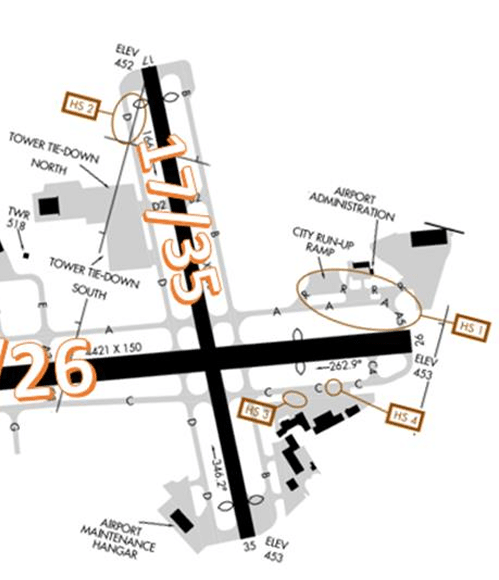
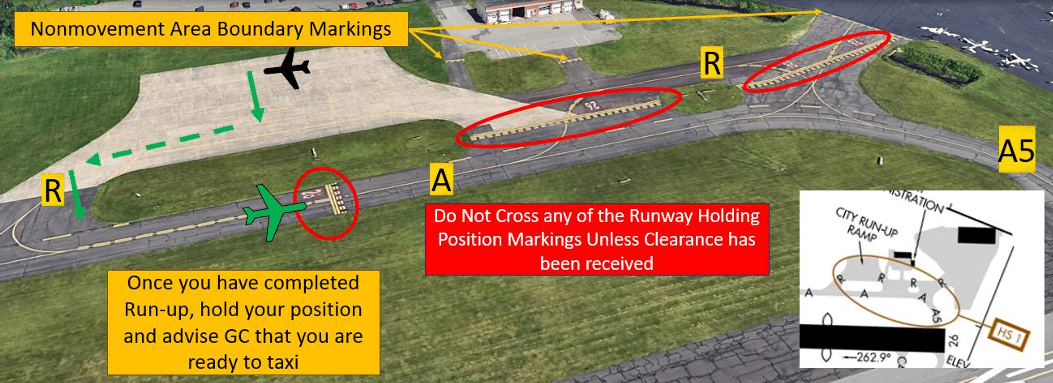
FAA has added a useful tool for confusing airports like Danbury. Start watching from 2:57 of this video for a visual understanding.
If in Doubt, Stop and Ask
A one-line call such as “Tower, confirm we are cleared across Runway 26?” costs seconds. Progressive taxi instructions are also available when a route is unclear.
Expectation Bias Can Override What You See
Both pilots expected the bars to be farther along, near the end of Alpha. When markings appear earlier than expected, treat that as new information and stop, rather than assuming they must not apply.
Use the PM as a Real-Time Chart Reader
The PM should track the taxi diagram during the entire taxi and call out hold short bars, runway crossings, and hot spots before reaching them. Both pilots realized the error after crossing, not before.
The Extension That Wasn’t: Flying on an Expired NEF
Captain’s Perspective
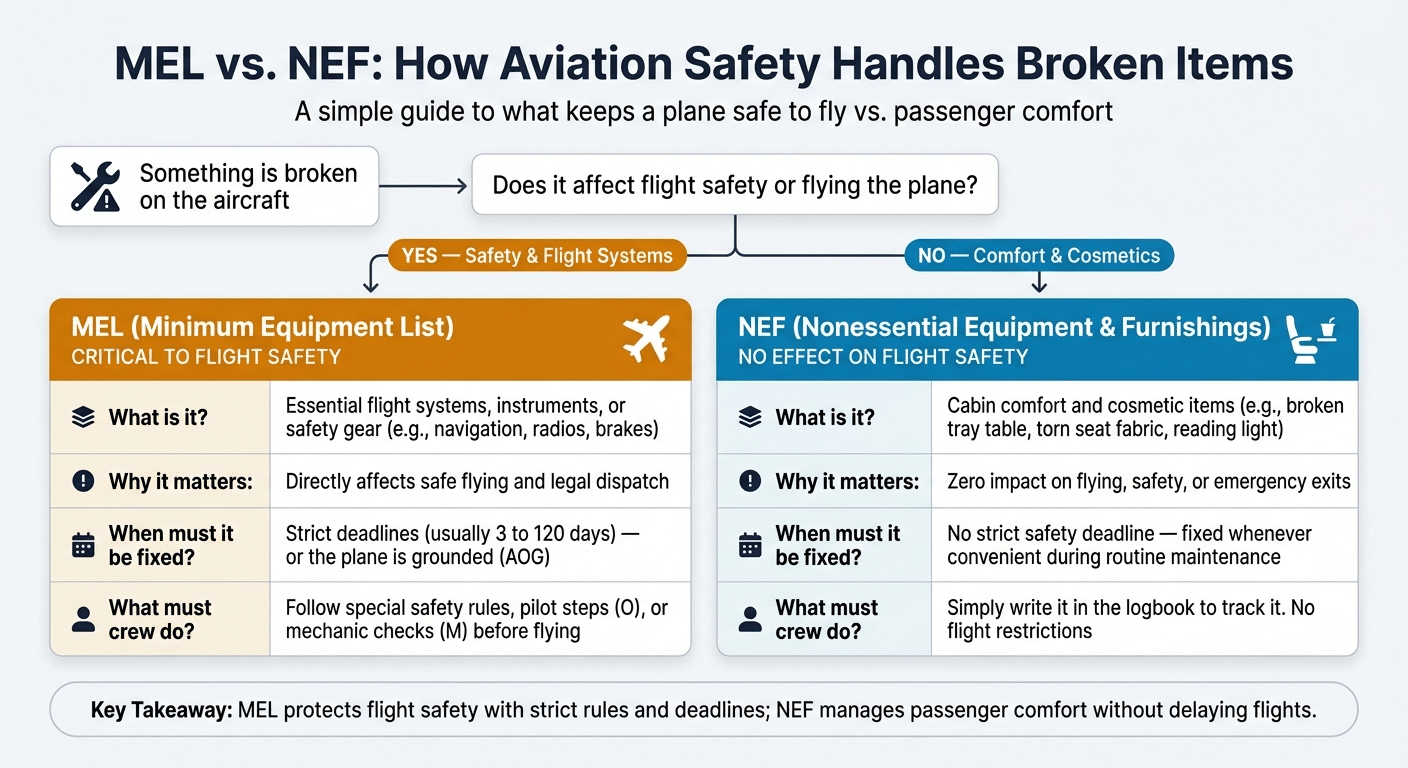
When I arrived for duty at 0530 on 09/29/26, I found a Non-Essential Furnishings (NEF) entry for an inoperative passenger phone system whose correct-by date, 9/26/26, had passed three days earlier. I showed the line entry to maintenance and continued preflighting. A maintenance worker later returned to the aircraft and told me another maintenance worker had extended the NEF and the aircraft was legal to fly.
I looked at the entry myself. A line had been drawn through the original correct-by date of 9/26/26, and someone had written “12/26/26” above it. I wasn’t sure this was a proper way to extend the item, so I called the on-call operations supervisor. Based on the updated maintenance entry, we both believed the flight would be legal. We completed all three legs that day.
On 09/30/26, I flew from [airport] to [another airport], still believing there was no issue with the aircraft’s legality. At about 2000 that evening, I was told the NEF extension was likely not legal. I was also told that the first extension of this NEF, back in May, likely wasn’t legal either.
At no point was any safety-of-flight issue in question, but every NEF and MEL item must be understood and followed. I believe pilots, myself included, need more training on NEFs and probably on MELs too.
Second in Command’s Perspective
During preflight and cockpit preparation on the morning of September 29, I was alerted to a NEF item. The pilot in command told me it had already been extended once and that it was being looked at for a further extension. Shortly afterward, maintenance came to the aircraft and told us the item was being extended again and that we were legal to fly. The pilot in command relayed the status to the assistant chief pilot, and the flight proceeded normally. Two days later, I was told the item should not have been extended.
I would suggest informing the pilot group of the requirements for extending certain NEF items. I see this as a good learning opportunity for what I believe is a low-priority safety concern. Maintenance can learn from this too, particularly about which NEF items can or cannot be extended more than once. Finally, it might be worth telling the owner and charter customers that the aircraft needs a break from the high work tempo so it can be pulled off the line and serviced.
ERC Acceptance & Closing Notes:
- Sole source.
- Company had added an instructional notice to all aircraft and sent this out to MX and pilot groups.
- Maintenance will brief the pilot group on the MEL and NEF process.
Safety Takeaways:
A Handwritten Change to a Date Is Not a Documented Extension
The captain noticed the right thing: a crossed-out date with a new one written above it. Extensions to deferred items normally have to follow a defined process, with an authorized approval and a proper entry. If an entry looks informal, treat that as a reason to look further.
Know the Rules for the Deferred Items You Fly With
The captain’s own conclusion, that pilots need more training on NEFs and MELs, is the right one. Operators should include how extensions are authorized and documented, not only how to read the list.
Reassurance from Several People Is Not the Same as Authority
A maintenance worker and an operations supervisor each said the aircraft was legal. Neither statement replaced the underlying documentation. Ask who approved the extension, under what authority, and where it is recorded.
Forgotten at the Gate: A Missed Customs Stop After a Long Night Return
A Hawker HS-125 landed at [airport] at about 21:21 local time on [date]. It had flown a 2-hour, 42-minute night leg from Bahamas. The trip began that afternoon as a “pop-up charter.” The aircraft departed [airport] at about 15:14 to take five passengers to Bahamas, then returned deadhead with only the crew aboard.
The crew was called to duty at about 11:45 a.m. and reached the hangar between 13:30 and 13:45. Company policy calls for international crews to arrive about 90 minutes before departure. That wasn’t practical here because the crew needed time to pack, file a flight plan, and travel to the aircraft. Scheduling made clear there was no urgency, and the scheduler even suggested the departure could slide if needed.
Weather was demanding in both directions. The crew met moderate to heavy, occasionally severe turbulence at all flight levels and scattered thunderstorms. Conditions worsened on the return, with weather systems along the entire route. Most of the return was flown at night with obscured skies and no moon, in continuous light to moderate turbulence with occasional heavy bursts. The report calls it “a very physical flight.”
After landing, the crew, both seasoned pilots with extensive domestic and international experience, taxied directly to their base at the FBO, put the airplane away, and left the airport. They had forgotten to stop first at the U.S. Customs location at [airport]. Company crews know from training that this stop is required.
At about 22:08, a company executive notified the crew of the missed check-in. Both pilots immediately returned to the hangar, arriving at 22:35, and notified Customs agents at 22:36 as requested. At about 23:18, Customs asked them to come to the Customs FBO nearby. There the agent checked their passports, had the PIC fill out a form, discussed the circumstances, offered advice on avoiding a repeat, and released them. The meeting was cordial and professional. Both pilots were on their way home by 00:12 on October 2.
The report attributes the lapse to fatigue from the early, unexpected call to duty and the physical demands of the round trip. It also notes that two experienced pilots made the same error at the same time under the same conditions.
ERC Acceptance & Closing Notes:
- Event is pending to be reviewed.
Safety Takeaways:
Fatigue Erodes Memory First, Especially for Routine Steps
The customs stop is a routine item, and routine items are what tired crews drop. Both pilots missed it at once, which shows that having two pilots doesn’t cover a shared lapse when both are depleted.
Pop-up Trips Leave Little Time to Prepare
A call at 11:45 for a 15:00 departure to an international destination compresses packing, planning, and preflight. Even without pressure from the scheduler, the time pressure was real. Operators should build in extra margin, and crews should speak up when it isn’t enough.
Put the Customs Stop on the Arrival Checklist
A step that lives only in training depends on memory. A line item on the arrival checklist or a written international-arrival card, with the customs location noted, turns it into a prompt that works when you’re tired.
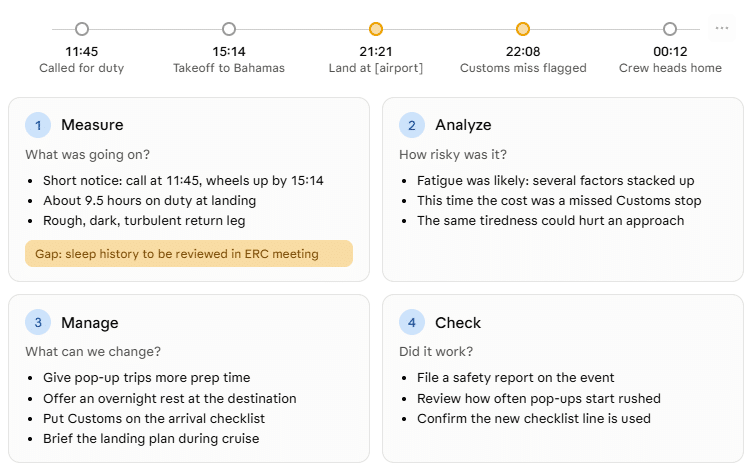
Fatigue Risk Management System (FRMS) Tool Application